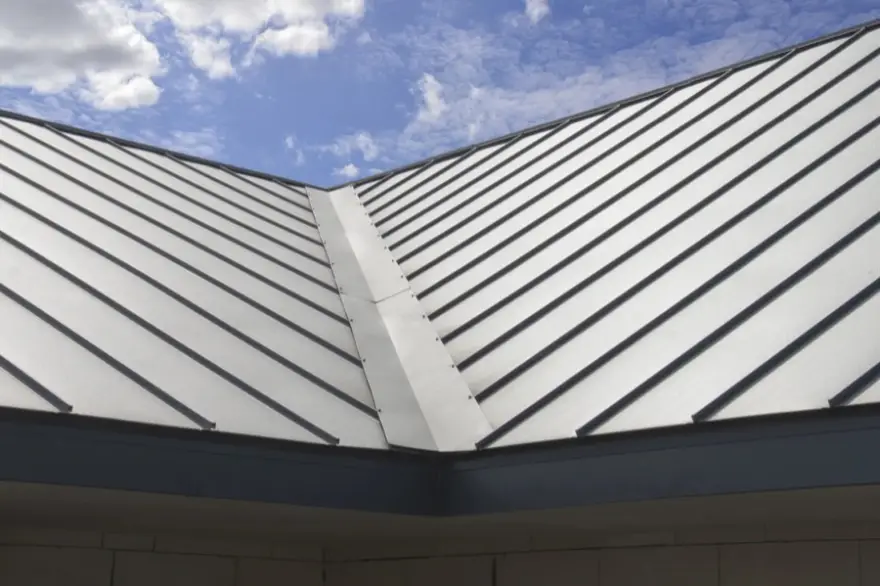
Standing seam vs exposed fastener at a glance
Both are panel roofs made from the same coated steel or aluminum. The difference is where the fasteners go, and that one detail drives slope limits, upkeep and price.
| Feature | Standing seam | Exposed fastener (5V, corrugated, rib) |
|---|---|---|
| How it attaches | Clips or a nail strip hidden under each raised seam | Screws through the panel face, each with a sealing washer |
| Panel coverage | About 16 to 18 in. (McElroy) | 24 in. for 5V, about 36 in. for rib panels |
| Lowest slope in Florida's code | 1/4 in. of rise per foot | 3 in. per foot, or 1/2 in. with lap sealant |
| Typical steel gauge | 24 gauge (26 on some 1-in. panels) | 26 gauge; 29 on some rib panels |
| Installed cost (HomeGuide, Nov 2025) | $900 to $1,600 per 100 sq ft | $500 to $1,200 per 100 sq ft |
| Gravity Roofing workmanship warranty | 10 years (24-gauge tier) | 7 years (26-gauge tier) |
Coverage figures come from McElroy Metal and Tri County Metals' Florida product approval. Gauges are the minimums in that approval.
How each one looks on a house
Standing seam reads as long, flat pans between raised ribs that run from eave to ridge. It looks clean and modern from the street, and no screw heads show.
Exposed-fastener roofs show rows of screws and a repeating rib. The 5V crimp profile has low ribs and a traditional Florida look. Direct Metal Roofing calls it the "Old-Florida profile," and Gravity Roofing pitches it for Cracker or Key West styles.
Corrugated is the wavy version, and taller rib panels like PBR look more like a barn. Our take: on a house, 5V is the exposed-fastener profile that looks most at home.
Oil canning on flat pans
Wide flat pans can show waviness called oil canning. Gulf Coast Supply, a Florida panel maker, says it is cosmetic and typically has no effect on performance. It adds that thicker gauges and striated panels lower the risk.
How each one is attached
Standing seam panels are held from underneath. Clips or a slotted nail strip fasten to the deck, and the next panel's seam locks over them. Gulf Coast says floating clips and nail slots let the metal expand and contract.
Exposed-fastener panels are screwed straight through the face into the deck or battens. Every screw is a hole sealed by a rubber washer. Gravity's comparison notes that this fastening method needs more attention to fastener condition over time.
Width also matters for labor. McElroy says standing seam covers about 16 to 18 inches per panel against about 36 for exposed-fastener panels. That means more panels, more seams and more time on the roof.
Slope limits
Florida's code lets standing seam go as low as 1/4 inch of rise per foot. Lapped, screw-down panels need 3 inches per foot, or 1/2 inch if the laps get sealant.
So a low back porch or a flat-ish addition often decides the question for you. Sheffield Metals, a panel supplier, adds that many snap-lock panels need 3:12 unless the maker approves lower.
Florida wind rules and uplift ratings
Florida's code tests both systems the same way. Through-fastened and standing seam panels must pass UL 580, ASTM E1592 or TAS 125. A 2-to-1 safety margin is then applied to the test results.
The rating belongs to the whole assembly, not the panel name. Tri County Metals' 2023 Florida approval, FL36904-R11, shows how much fastener spacing moves the number on 15/32-inch plywood.
| Assembly (Tri County, FL36904-R11) | Spacing | Max design pressure |
|---|---|---|
| 26-ga 5V crimp, screws through the face | 16 in. | -67.5 psf |
| 26-ga 5V crimp, screws through the face | 6 in. | -120 psf |
| 24-ga 1.5 in. snap-lock standing seam, clips | 12 in. | -75 psf |
| 24-ga 1.5 in. snap-lock, continuous clip | screws 6 in. | -146 psf |
| 24-ga 1.5 in. mechanical seam, clips | 6 in. | -176 psf |
On paper, a tightly screwed 5V roof out-rates a loosely clipped snap-lock.
The same approval's wind table shows what a house needs. At a 140-mph design wind speed, a 20-foot enclosed house in Exposure B needs -34.6 psf in the main field. Its corner zone needs -60.0 psf.
Your permit lists your home's actual wind speed. Ask the roofer for the approval number and the exact system row they're building, then check the spacing on the roof.
Heat, sun and paint finishes
Both systems use the same coil and the same paints, so color and finish don't separate them. Gulf Coast Supply offers 50-year, one-time transferable warranties on both PVDF and SMP paint for its panels.
Heat does hit the screws, though. McElroy says UV can shrink and crack the neoprene washers on exposed fasteners, generally after at least 20 years. Orlando's average July high is 92.0°F (NOAA 1991–2020 normals), so the roof gets plenty of sun.
For cooling, color matters more than system. The EPA says cool roofs can cut peak cooling demand 11% to 27%. Our post on the best metal roof color for Florida has the reflectance numbers.
Maintenance: screws vs seams
The upkeep gap is the real story in standing seam vs exposed fastener. On a screw-down roof, the washers age and screws can back out. McElroy's fix is to remove the old fasteners and drive new ones.
Gravity says exposed fasteners and washers should be inspected periodically. Standing seam has none on the face, so checks focus on flashing, penetrations and seams. Gravity points out that flashing and laps matter as much as the panel in wind-driven rain.
McElroy frames screw-down upkeep as light work every 20 to 30 years. For owners who accept that, it says the standing seam upcharge may not pay off. Our exposed fastener metal roof guide covers screw checks in detail.
Lifespan and warranty
Gravity Roofing publishes its own expected lifespans by tier: 50-plus years for 24-gauge standing seam and 25 to 40 years for 26-gauge exposed fastener. Its workmanship warranty is 10 years on the first and 7 on the second.
A study sponsored by the Metal Construction Association and the Zinc Aluminum Coaters Association projected more than 60 years for unpainted Galvalume standing seam. That projection assumed at least yearly maintenance.
HomeGuide says corrugated roofs in high-humidity climates typically last 30 to 50 years, and standing seam longer. More on Florida lifespans is in how long a metal roof lasts in Florida.
Standing seam vs exposed fastener cost in Orlando
JA Edwards, an Orlando roofer, publishes $18,000 to $35,000 for standing seam on a typical home. It does not publish an exposed-fastener price.
National guides agree on the gap. HomeGuide (Nov 21, 2025) puts exposed fastener at $500 to $1,200 per 100 square feet installed, against $900 to $1,600 for standing seam. Angi (updated Sep 25, 2026) says exposed fasteners run 30% to 50% less.
McElroy, a panel maker, says concealed-fastener systems generally cost about 50% more. It blames narrower panels, bulkier shipping and crating.
Direct Metal Roofing will write a standing seam and a 5V quote side by side. That's the cleanest way to see the gap on your own roof.
Corrugated vs standing seam
Corrugated is the low end of the exposed-fastener range. Angi lists corrugated at $3.50 to $15 per square foot and standing seam at $7 to $30. See metal roof cost in Orlando for more local numbers.
Which fits an Orlando house
Pick standing seam if
- You plan to keep the house for decades and don't want screw checks.
- Any part of the roof is below 3 inches of rise per foot.
- You want the clean modern look, or the longer workmanship warranty Gravity ties to it.
Pick exposed fastener (5V, corrugated, rib) if
- Budget comes first and the roof is 3:12 or steeper.
- The house suits an old Florida 5V look, or it's a porch, garage or outbuilding.
- Someone will inspect the screws and washers and replace them when they age.
Our view: on a main house in Orlando, standing seam earns its premium if you'll stay. On a workshop or carport, 5V or rib panel is the sensible spend. Full details are in our standing seam metal roof guide.
Orlando roofers that install both
These roofers on our list install standing seam and exposed-fastener panels, per their own websites, so one visit can price both.
- Gravity Roofing: standing seam plus Ultra Rib, 5V and PBR, with published lifespans and warranty by tier.
- Mid Florida Exteriors: a metal-only roofer listing 24- and 26-gauge standing seam, 26- and 29-gauge rib and 5V.
- T Mark Metal Roofing: standing seam roll-formed on site, 26-gauge Galvalume 5V crimp, Ultra Rib and PBR for low slopes.
- Direct Metal Roofing: standing seam, 5V crimp and R-panel, quoted side by side.
Compare every installer on our list of the best metal roofers in Orlando.
Sources: Florida Building Code 2023, Chapter 15; Tri County Metals, FL36904-R11 evaluation report (issued Jun 24, 2024); McElroy Metal, Cost Difference Between Standing Seam and Exposed Fastener Panels (May 17, 2022); Gulf Coast Supply, Oil Canning; Gulf Coast Supply, Product Warranties; Gravity Roofing, Metal Roofing in Central Florida; Construction Specifier, MCA and ZAC service life study (Dec 9, 2014); HomeGuide, Metal Roof Cost (Nov 21, 2025); Angi, How Much Does a Metal Roof Cost? (updated Sep 25, 2026); JA Edwards of America, Metal Roofing Orlando; NOAA 1991–2020 Climate Normals, Orlando International Airport; EPA, Using Cool Roofs; Direct Metal Roofing, Metal Roofing; Mid Florida Exteriors, Metal Roofing; T Mark Roofing, Roof Systems; T Mark Roofing, FAQ; Sheffield Metals, Standing Seam vs. Stamped Metal Shingles (Sep 1, 2022). Checked Nov 8, 2026.
Price a metal roof for your house
Tell us which metal roof you're leaning toward. Two sponsored metal roofers will quote it.