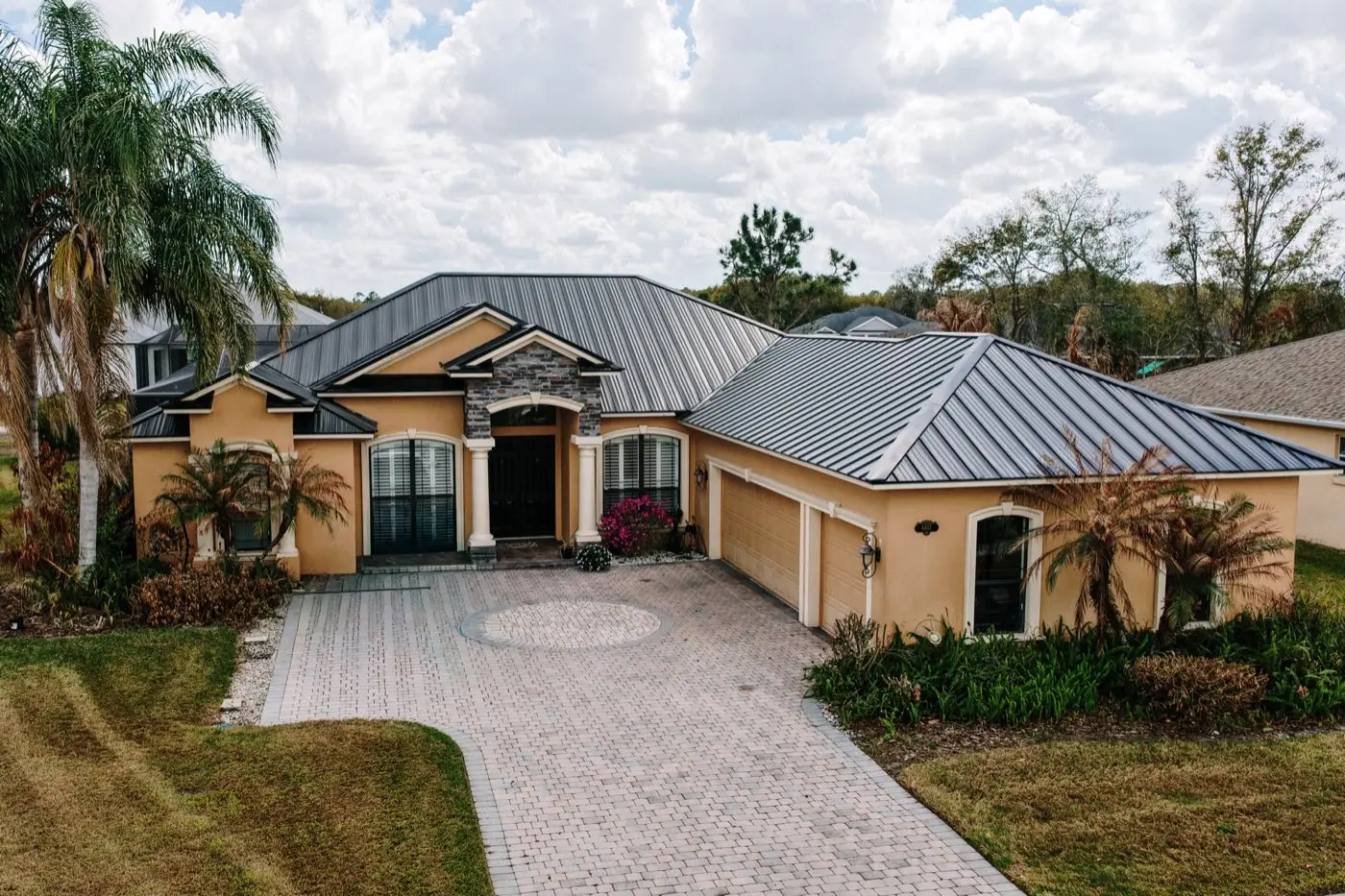
Metal roof gauge thickness in inches
Gauge runs backward: the lower the number, the thicker the steel. Here is one panel maker's chart of nominal thickness, with HomeGuide's note on where each gauge fits.
| Gauge | Nominal thickness | Weight per sq ft | HomeGuide says it's best for |
|---|---|---|---|
| 22 | 0.030 in. | 1.25 lb | Commercial or high-end residential |
| 24 | 0.024 in. | 1.00 lb | Homes and businesses in severe-weather areas |
| 26 | 0.018 in. | 0.75 lb | Homes in mild to moderate climates |
| 29 | 0.014 in. | 0.56 lb | Small barns or sheds in mild climates |
Thickness and weight are from Metal America, a panel maker. Florida's code lists 26-gauge galvanized or AZ50 steel at a 0.0179-inch minimum for flashing.
On this chart, 29 gauge vs 26 gauge metal roofing is a 0.004-inch gap, and 24 gauge adds another 0.006 inch.
Gauge is also a range, not one number. Western States Metal Roofing says 26 gauge can run from .0179 to .0217 inch. Ask for the thickness in decimals on any quote.
Which systems use 24, 26 and 29 gauge
Florida product approvals set the minimum gauge for each panel. Tri County Metals' 2023 approval, FL36904-R11, is a good map of how it usually breaks down.
- Standing seam: 24-gauge minimum for its snap-lock and mechanically seamed panels. The one exception is a 1-inch nail-strip panel, approved at 26 gauge.
- 5V crimp and PBR: 26-gauge minimum.
- Ultra Rib: 29 gauge in high-strength Grade 80 steel, or 26 gauge in Grade 50.
That Ultra Rib line matters. In this approval, 29 gauge is only allowed in stronger 80 ksi steel, so thinner sheet is paired with harder metal.
Metal shingles vary. ProVia makes its shingles from 26-gauge steel, while Sheffield Metals says stamped shingles are typically 29 gauge. Aluminum is sold by decimal thickness, such as .032 inch, not gauge; see aluminum vs steel metal roofs.
Florida wind ratings by gauge
Tri County's approval has one clean side-by-side. Its 1-inch snap-lock panel goes over plywood, with the old shingles allowed to stay, using the same screws 5¼ inches apart.
| Assembly (FL36904-R11) | Gauge | Max design pressure |
|---|---|---|
| 1-in. snap-lock over plywood, optional old shingle layer | 26 | -52.5 psf |
| 1-in. snap-lock over plywood, optional old shingle layer | 24 | -116 psf |
| Ultra Rib, by deck, battens and screw spacing | 29 | -41.7 to -138.5 psf |
| Ultra Rib on battens over plywood | 26 | -116.25 to -135 psf |
Going from 26 to 24 gauge more than doubled the rating in that matched pair. The 29 gauge vs 26 gauge metal roofing rows are murkier: deck, battens and screw spacing swing those ratings just as far. If you're keeping the old shingles under the metal, read our guide to a metal roof over shingles in Florida.
The same approval's wind table shows the target. At a 140-mph design wind speed, a 20-foot enclosed house in Exposure B needs -34.6 psf in the main field. Its corner zone needs -60.0 psf.
Florida's code applies a 2-to-1 safety margin to wind test results. In the High-Velocity Hurricane Zone, it also requires steel panels and shingles of at least 26 gauge. Orlando is outside that zone, but the rule shows where the state draws the line.
Dents, hail and oil canning
Thicker metal resists visible dents. Sheffield says 24-gauge rigidity helps resist hail dents and keeps the panel from taking the shape of the deck below.
ABC Metal Roofing makes a fair point the other way. A 29-gauge panel can carry the same UL impact rating as a 26-gauge panel. Even so, ABC says thicker panels are less prone to denting.
Oil canning, the waviness in flat areas of a panel, also tracks gauge. Gulf Coast Supply says thicker gauge material usually carries less risk, and that it's a cosmetic issue. On standing seam with wide flat pans, that's one more reason to lean toward 24.
Paint, coating and heat
Gauge doesn't change the corrosion coating. Florida's code sets AZ50 Galvalume or G-90 galvanized as the minimum at any gauge. Tri County's approval lists the same coatings and paints for its 24-, 26- and 29-gauge panels.
Gulf Coast Supply's warranty page lists its paint warranties by finish, not by gauge. Heat on the house comes down to color: the EPA says cool roofs can cut peak cooling demand 11% to 27%.
Maintenance by gauge
On 5V and rib panels, gauge doesn't change the screw checks. The screws and washers, not the sheet thickness, are what need checking. Our exposed fastener metal roof guide covers what to look for.
Foot traffic is where thin metal shows its age. Sheffield says thin stamped shingles can dent when walked on. Ask your roofer how service techs, solar crews and A/C installers will cross the roof.
Lifespan and warranty by gauge
Gravity Roofing ties its warranty to gauge. Its 24-gauge standing seam tier gets a 10-year workmanship warranty and a 50-plus-year expected lifespan. Its 26-gauge exposed-fastener tier gets 7 years and 25 to 40 years.
That tier changes the system as well as the gauge, so it isn't a pure gauge test. Still, it's the clearest published example we found of an Orlando-area roofer backing thicker metal as the longer-lived roof.
Cost by gauge
HomeGuide (Nov 21, 2025) lists material prices per square foot by gauge. It shows 29 gauge at $1 to $3, 26 gauge at $1.50 to $5, and 24 gauge at $3 to $7.
On 24 gauge vs 26 gauge metal roof pricing, Sheffield says 24 costs about 8% to 15% more in material. Angi (updated Sep 25, 2026) gives a wider spread. It runs from $4 to $10 per square foot for 29 gauge up to $20 to $30 for 22 gauge.
Material is only part of the bill. For installed prices by system, see metal roof cost in Orlando.
Which gauge fits an Orlando house
24 gauge
Our pick for standing seam on a house. Most standing seam in Tri County's approval requires it, Metal America recommends it for homes, and it cuts oil canning risk. It's the safer call on the 24 gauge vs 26 gauge metal roof question for long panel runs.
26 gauge
The normal choice for 5V crimp and rib panels on a house, and the code floor in South Florida's strictest zone. It also works for 1-inch nail-strip standing seam when the approval lists it and budget is tight.
29 gauge
Fine for sheds, barns, carports and workshops. On a house, we'd only use 29 gauge vs 26 gauge metal roofing savings if the approval row covers your roof's design pressure in writing.
Whatever you pick, make sure every quote names the same gauge. Our standing seam metal roof guide covers the rest of the panel choices.
Orlando roofers that publish their gauges
These roofers on our list name the gauges they install, which makes quotes easier to compare.
- Mid Florida Exteriors: 24- and 26-gauge standing seam, and 26- and 29-gauge rib panel.
- T Mark Metal Roofing: recommends 26 gauge for homes and 24 for commercial work. It says many of its standing seam jobs are 24, and that 29 is mainly for metal building walls.
- Gravity Roofing: 24-gauge standing seam and 26-gauge exposed-fastener tiers, with different warranties.
- Fiddler's Roofing: Metal Alliance concealed-fastener panels in 24 and 26 gauge.
Compare them all on our list of the best metal roofers in Orlando.
Sources: Metal America, Metal Roofing Panel Gauges Explained (updated Aug 14, 2026); HomeGuide, Metal Roof Cost (Nov 21, 2025); Florida Building Code 2023, Chapter 15; Tri County Metals, FL36904-R11 evaluation report (issued Jun 24, 2024); Western States Metal Roofing, 29 vs 26 Gauge (Feb 21, 2020); Sheffield Metals, Should You Use 24-Gauge Steel? (Mar 7, 2025); Sheffield Metals, Standing Seam vs. Stamped Metal Shingles (Sep 1, 2022); ABC Metal Roofing, Metal Panel Gauges (Aug 15, 2016); ProVia, The Science of Metal Roofing; Gulf Coast Supply, Oil Canning; Gulf Coast Supply, Product Warranties; EPA, Using Cool Roofs; Gravity Roofing, Metal Roofing in Central Florida; Angi, How Much Does a Metal Roof Cost? (updated Sep 25, 2026); Mid Florida Exteriors, Metal Roofing; T Mark Roofing, FAQ; Fiddler's Roofing, Residential Metal Roofing. Checked Nov 8, 2026.
Price a metal roof for your house
Tell us which metal roof you're leaning toward. Two sponsored metal roofers will quote it.